.svg)
Subscribe to our newsletter and get insights on how to grow your personal brand.
Thank you! Your submission has been received!
Oops! Something went wrong while submitting the form.
.svg)


A real SaaS content marketing strategy does more than just fill a blog with posts. It’s the game plan for attracting, converting, and keeping your ideal customers.
This is the bedrock that connects every single tweet, case study, and article back to what actually matters: trial sign-ups and revenue growth. Without this foundation, you’re just making noise. With it, you’re building a predictable engine for growth.
Before you write a single word, you need a plan. Too many founders jump straight into keyword research and start banging out articles. That’s a huge mistake. It’s how you end up with content that nobody reads and that fails to convert high-value customers.
This initial work is what separates content that just exists from content that drives your business forward. It’s about being deliberate. You'll stop guessing what your audience wants and start creating the exact resources they’re already looking for.
Forget those flimsy, one-dimensional buyer personas like "Marketing Mary." An effective SaaS content strategy is built on a rock-solid Ideal Customer Profile (ICP).
Your ICP isn't some made-up character. It’s a laser-focused definition of the company that gets the most value from your product—and in turn, gives the most value back to you. We're talking high LTV, low churn, and the customers who become your biggest fans.
How do you build it? Talk to your best customers.
The entire point of these conversations is to get inside your user's head. You want your content to feel like it was written just for them. That level of empathy is a massive competitive advantage.
Once you know exactly who you're talking to, you need to map out how they make a buying decision. The SaaS customer journey is never a straight line. It's a winding path with tons of touchpoints, and your content needs to be there to guide them every step of the way.
To really get this right, you need a tactical SEO strategy built for the way SaaS businesses grow. Mapping the journey means creating specific pieces of content that answer questions at each stage. You can see more on how we build out a powerful content creation strategy that fuels this entire process.
Awareness Stage
People at this stage know they have a problem, but they don't know what the solution is yet. They're Googling broad, informational terms.
Consideration Stage
Okay, now they're actively researching solutions. They know what kind of tool they need, and they're starting to compare their options.
Decision Stage
They've narrowed it down to a final few, and you're on the shortlist. They're ready to pull the trigger but need that final push.
A brilliant strategy is just a nice idea on paper without a system to bring it to life. This is where we stop planning and start doing. We're going to design your content engine—the real-world, operational framework that turns your strategy into a consistent stream of content that actually moves the needle.
Without a documented process, even the most creative teams eventually fall into chaos. You’d be surprised how common this is.
In the cutthroat world of SaaS, a wild 71% of marketers are struggling to see real results from their content. That means only 29% feel their strategies are actually working. This gap almost always comes down to the lack of a clear, repeatable system. As you build out your engine to dominate search, you’ll also want to keep an eye on the best AI SEO tools for Generative Engine Optimization to stay ahead of the curve.
Let’s start with your content pillars. These are the big, foundational themes you want to completely own in your industry. I'm not just talking about keywords here; these are broad, strategic topics that connect your ICP's biggest headaches directly to your product's solutions.
Think of them as the main sections of your company's library of expertise.
For example, a project management SaaS isn't just targeting "project management software." Their pillars would be much broader, like:
Every single piece of content you create—from a quick top-of-funnel blog post to a detailed, bottom-of-funnel webinar—should ladder up to one of these pillars. This focus is what builds your authority and makes your content machine scalable.
Here's a simple way to visualize how your core strategy feeds directly into your content plan.

As you can see, a winning content plan isn't built on random acts of content. It’s the direct result of knowing exactly who you're talking to and what you need to say.
Not all content is created equal. The blog post that grabs someone's attention for the first time is completely different from the case study that convinces them to sign up. You have to match the format to where your prospect is in their buying journey.
A huge mistake I see all the time is companies just pumping out blog posts and expecting them to do everything. A smart SaaS content strategy uses different tools for different jobs, meeting buyers exactly where they are.
This table breaks down how to map your content formats across the SaaS funnel. It's a simple framework, but it's incredibly powerful for making sure you have the right assets to guide prospects from "Who are you?" to "Take my money."
When you build out your content plan this way, you ensure you have the right assets ready to support a prospect's entire journey with you, leaving nothing to chance.
Your editorial calendar is where the rubber meets the road. A good calendar isn’t just a list of topics and due dates; it’s a strategic command center that aligns every piece of content with your larger business goals.
Let's walk through a real-world example. Imagine your B2B SaaS company is launching a new "Team Analytics" feature next quarter.
This is the "create once, distribute forever" mindset. It maximizes the ROI on your effort and prevents your team from burning out. You turn one big push into a waterfall of assets that fills the calendar, supports the product launch, and engages prospects everywhere they hang out.
That's how you build a content engine that actually scales.
You can create the greatest piece of content in the world, but if you just hit "publish" and walk away, you've essentially built a brilliant product and left it to collect dust in a warehouse.
The real work—and the real growth—starts after you publish. This is where you strategically get that content in front of your ideal customers. It’s the difference between content feeling like a cost center and becoming a predictable growth engine for your SaaS.
A smart distribution plan isn't about spamming links everywhere. It's a multi-channel approach that meets your audience where they already hang out, building trust and authority with every post, email, and share.
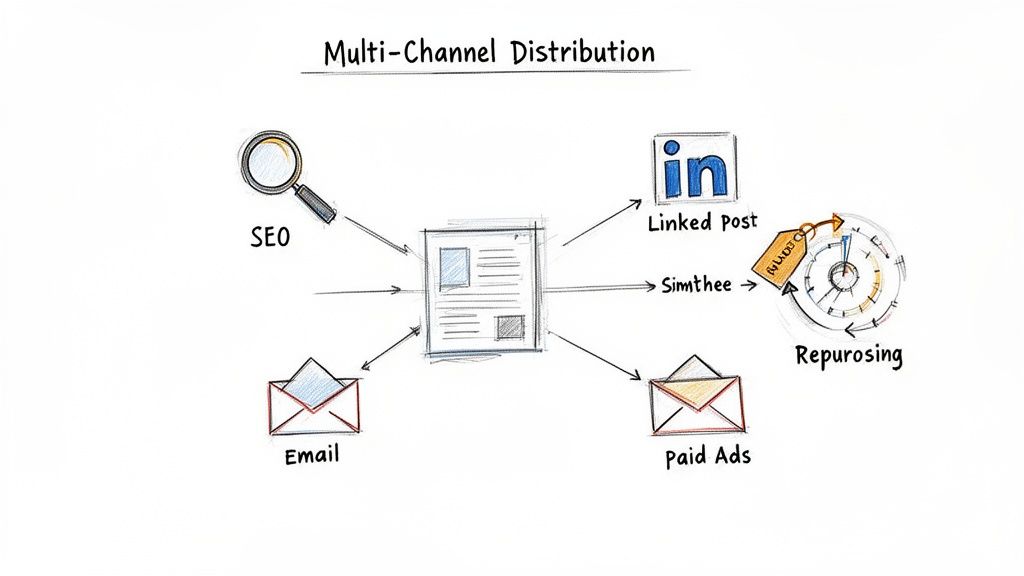
Search Engine Optimization is the foundation of any scalable SaaS content plan. I'm not talking about short-term traffic spikes. I'm talking about building a long-term, defensible asset that consistently brings in qualified leads.
Think of every high-ranking article as a digital salesperson working for you 24/7, for free.
The trick is to create content that answers what people are searching for so damn well that Google has no choice but to rank you. This means getting inside your ICP's head and understanding the exact keywords they use at every stage—from "what is..." to "best software for..."
Your end goal is to build an "SEO moat"—a whole ecosystem of content that solidifies your authority. When someone has a problem in your niche, your brand should be the one they find with the answer.
While SEO is the long game, platforms like LinkedIn offer immediate shots on goal with high-value decision-makers. For B2B SaaS, this is non-negotiable.
But please, don't be the person who just drops a link to your latest blog post with a generic "Check out our new article!" caption. Nobody cares.
People on social media are there to learn something, be entertained, or feel inspired—not to be sold to.
The secret to LinkedIn is to treat it like its own content platform, not just a billboard for your blog. Share native insights, spark conversations, and build your personal and company brand through authentic expertise.
Here’s a practical way to do it:
Your email list is one of the only marketing channels you truly own. It's a direct line to your most engaged followers, and it deserves respect.
A great SaaS newsletter is not a weekly promotion blast. It's a curated source of value that guides leads from being curious to becoming customers.
Instead of just announcing your new posts, frame your newsletter as a "can't-miss" digest of industry knowledge that helps subscribers get better at their jobs.
Pro Tip: Add a section that curates the best content from other thought leaders in your space. This positions you as a trusted guide, not just a self-promoter, and will dramatically increase your open rates and build real loyalty.
The most efficient SaaS marketing teams don't just create more content. They operate a content repurposing flywheel, squeezing every last drop of value from their best assets. This is how you scale your reach without scaling your budget or burning out your team.
Think of one major piece of content as your "anchor," then break it down into smaller "atomic" pieces for different channels.
Here’s what this looks like in action:
This system turns one big effort into weeks of high-value content, making sure your message is seen everywhere your audience looks. It's the smartest way to build a sustainable distribution machine.
Look, anyone can write a blog post. But creating content that slices through the noise and grabs the attention of a busy exec? That's a different game entirely. Your SaaS content strategy can't just be about volume; it has to prioritize formats that deliver a real punch and a solid return on your time and money.
This means you have to think beyond the blog. It's time to embrace a mix of media that builds genuine trust, shows off your product's value, and actually gets people to take action. Some formats are just flat-out better at telling your story in a way that resonates.

Video isn't a "nice to have" anymore—it's a must. It's the core of any modern SaaS content plan. Video is crushing it across every stage of the buyer's journey, and short-form clips are especially gold for grabbing attention and keeping customers around. While some marketers—41.5% to be exact—still swear by infographics, video's direct line to the sales pipeline is just undeniable. For a deeper dive, check out the reign of video in content marketing on bayleafdigital.com.
And no, you don't need a Hollywood budget. Authenticity almost always beats high production value.
When a prospect is on the fence, nothing closes the deal like a killer case study. This is your chance to show real, tangible proof that your product delivers results for companies just like theirs.
But let's be honest, most case studies are a snooze-fest. Don't let yours be one of them. The secret is to tell a compelling story.
A great case study isn't a spec sheet. It's a story. The customer is the hero, their problem is the villain, and your product is the magic sword that helps them win the day.
Structure your case studies to hit hard:
Once you have a solid case study, you can easily package it into a downloadable asset to generate more leads.
Want to truly own a conversation in your industry? Create your own original research or a data-backed report. This is the ultimate power move. It instantly positions your brand as a thought leader, not just another company rehashing the same old blog posts.
This doesn't have to be some massive, expensive academic study. You can start small by looking at the data you already have.
This kind of content is a magnet for links and PR. When you become the source for a key industry stat, everyone—blogs, journalists, influencers—will be linking back to you for years. You’re not just writing an article; you’re building a powerful SEO moat around your brand.
Posting content without tracking what happens next is just guesswork. You're flying blind.
You might feel like you're making progress, but you have no real idea if you're actually moving the needle for the business. A real saas content marketing strategy isn't a "set it and forget it" activity—it's a living system that needs constant feedback to get better.
Let's get past the vanity metrics. Page views and social shares feel good, but they don't keep the lights on. For a SaaS company, the only numbers that truly matter are the ones tied directly to revenue: lead quality, trial sign-ups, conversion rates, and the impact on your Customer Acquisition Cost (CAC).
First things first, you need a single source of truth for your content's performance. You don't need some ridiculously expensive, complicated tool to get started. A simple dashboard in Google Analytics 4 (GA4) or a similar platform will give you 90% of what you need.
The whole point is to see how people who interact with your content actually move through your funnel.
Don’t just track what happens on the page; track what happens after the page. A blog post with 1,000 views and zero trial sign-ups is a failure. A post with 100 views that generates five qualified trials is a massive win.
Not all your content is created equal. Let's be honest, some of your older posts might be collecting dust or, even worse, hurting your brand.
A regular content audit—I recommend doing one every quarter—is your chance to prune what isn't working and pour gasoline on what is.
The process is surprisingly straightforward:
This keeps your site a high-quality resource, which is exactly what Google and your potential customers want to see.
At the end of the day, your content ROI needs to be framed in the language of the C-suite. How is this content strategy making the company money or saving it money?
One of the best arguments for content is its sheer efficiency. SaaS content marketing costs 62% less than traditional marketing while delivering way better results. It’s no surprise that 75% of companies planned to increase their content budgets in 2023, and over half were projected to do it again in 2024. If you want to dive deeper, you can discover more insights about SaaS content statistics on mailmodo.com. This kind of efficiency is a game-changer for founders and marketers who have to justify every dollar.
Connect your content numbers to the KPIs that matter:
When you consistently measure, audit, and optimize, your content stops being a random collection of articles. It becomes a predictable, scalable growth engine that proves its worth quarter after quarter.
Let's be real—building a content strategy from the ground up brings up a ton of questions. I hear them all the time from founders. Here are the most common ones I get, with straight-up answers.
There's no one-size-fits-all number here, but I always tell early-stage SaaS companies to earmark around 20-30% of their total marketing budget for content. It's less about the exact dollar amount and more about committing enough to be relentlessly consistent.
The goal isn't just to spend money. It's to fund a strategy that lets you create and promote content steadily. Start there, watch your metrics like a hawk (especially lead quality and CAC), and then double down on what’s actually bringing in a return.
Let me be blunt: content marketing is a long game. It's not a magic bullet. You might see a few small traffic bumps in the first couple of months, but you're looking at a solid 6-9 months of consistent, high-value work before you see a real, predictable impact.
And by "impact," I mean measurable lifts in organic traffic, a steady flow of qualified leads, and more trial sign-ups.
You're not trying to create a flash-in-the-pan traffic spike. The whole point is to build a sustainable growth engine—a defensible asset that keeps paying dividends for years. Patience isn't just a virtue here; it's a requirement.
This is the make-or-break point. The companies that win are the ones who don't give up three months in.
The game has changed. Foundational blog posts still have their place, but the content that's really moving the needle today is practical, personal, and meets your ideal customer right where they are.
Here are the formats I see delivering the biggest wins:
Yes. 100%. This is hands-down one of the biggest (and most expensive) mistakes I see SaaS companies make. Going all-in on top-of-funnel (ToFu) blog posts is like building a massive, beautiful storefront but having no one inside to help customers actually buy something.
You need a balanced approach that guides people from their first Google search all the way to swiping their credit card.
Covering the whole funnel means you’re not just attracting an audience—you’re turning that audience into revenue.
At Legacy Builder, we don't just create content; we build content engines that drive real growth. We’ll help you turn your expertise into an authentic brand that connects, converts, and builds your legacy. Find out how we do it at https://www.legacybuilder.co.


You could – but most in-house teams struggle with the nuance of growing on specific platforms.
We partner with in-house teams all the time to help them grow on X, LI, and Email.
Consider us the special forces unit you call in to get the job done without anyone knowing (for a fraction of what you would pay).
Short answer – yes.
Long answer – yes because of our process.
We start with an in-depth interview that gives us the opportunity to learn more about you, your stories, and your vision.
We take that and craft your content then we ship it to you. You are then able to give us the final sign-off (and any adjustments to nail it 100%) before we schedule for posting.
No problem.
We have helped clients for years or for just a season.
All the content we create is yours and yours alone.
If you want to take it over or work on transitioning we will help ensure you are set up for success.
We want this to be a living breathing brand. We will give you best practices for posting and make sure you are set up to win – so post away.
Subscribe to our newsletter and get insights on how to grow your personal brand.
